Garage Clearance: Recycling and Sustainability Policy
Garage Clearance is committed to a clear, measurable sustainability plan that reduces waste, supports local reuse and drives down carbon from every clearance job. Our garage clearance services prioritise reuse, repurposing and responsible recycling so that fewer items go to landfill and more materials re-enter the local circular economy.Our Recycling Percentage Target
We have set a public recycling percentage target to hold our team accountable and drive continuous improvement. Our goal is to achieve a 90% recycling and reuse rate for all garage clearances by 2028, with interim milestones of 75% by the end of next year and 85% within two years. This target covers material reuse, donation, processing at transfer stations and diversion into specialist recycling streams.
How we measure and report
We monitor tonnes diverted, items donated and material streams recovered so we can publish clear results internally and incorporate learnings. Measurement includes segregated loads for metals, timber, glass, plastics, textiles, and WEEE (waste electrical and electronic equipment). Strong data tracking helps us improve every route and every clear-out.To make the target concrete we partner with local transfer stations and Materials Recovery Facilities (MRFs). Garage clearances often start with a rapid onsite sort, then materials that cannot be reused are taken to borough-run transfer stations or household waste recycling centres where specialist sorting and processing happens. These local civic amenity sites support council-led kerbside separation schemes ??? for example, organics, paper and cardboard, glass and rigid plastics are frequently handled separately in many boroughs, and we feed separated loads into those channels.
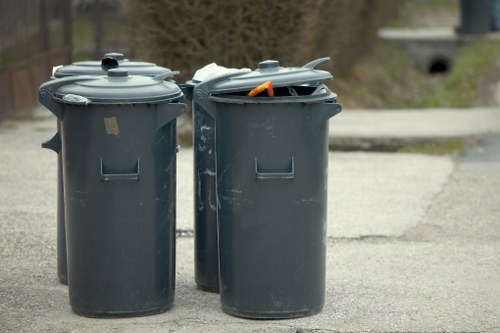
 We tailor our approach to the local boroughs' approach to waste separation. In areas with advanced kerbside sorting we match the council colour-coded system so residual contamination is minimised. In boroughs still developing collection streams we consolidate recyclable fractions for delivery to the most appropriate reuse or recycling facility. Our teams are trained to identify items suitable for reuse, from furniture and tools to bikes and gently used storage units, and to separate hazardous components (small batteries, oils, solvents) for the correct specialist disposal.
Our network includes the following standard disposal and reuse routes:
- Donation to local charities and community reuse centres for items still in good condition
- Delivery to transfer stations or household recycling centres for sorting at a MRF
- Direct recycling of metals, timber and construction rubble at licensed processing plants
- Secure, certified processing for WEEE, batteries and automotive fluids
We maintain active partnerships with charities and social enterprises so that usable items from garage clearances have a second life. By co-operating with local charities, community projects and social enterprises we help keep furniture, tools, appliances and textiles in use. Donations are vetted for safety and functionality; items that are repairable are routed to community repair cafes or upcycling initiatives rather than being scrapped. These partnerships not only improve our reuse rate but also deliver tangible community benefits.
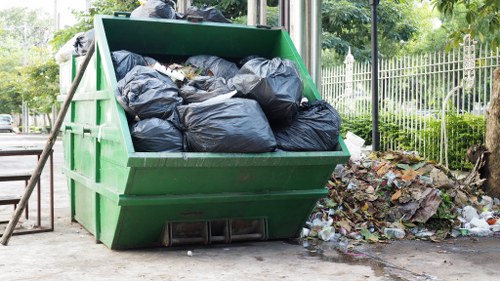 Sustainability is built into our transport strategy. We operate a growing fleet of low-carbon vans including electric and hybrid models, and we use route optimisation software to reduce mileage and emissions. Every garage clearance job is planned to maximise load fill and minimise unnecessary trips. Telematics and driver training contribute to smoother driving, lower fuel consumption and reduced particulate and NOx emissions across urban and suburban runs.
![A person dressed in a black suit with hands resting on a wooden table has their head replaced by a large, silver metal waste bin filled with crumpled white paper. The waste bin is cylindrical with a mesh design and is overflowing with the paper, some of which is slightly spilling over the rim. The background is neutral grey, highlighting the contrast between the clean, textured metal bin and the white paper. This image symbolizes rubbish or waste disposal, aligning with the services provided by Garage Clearance for rubbish removal and recycling. The setting appears to be an indoor environment, possibly an office or workshop, emphasizing the importance of waste management in professional or domestic contexts. The visual combines a humorous, conceptual approach to waste collection, subtly supporting themes of recycling and responsible rubbish disposal relevant to the local area around [POSTCODE] or [TOWN], within the UK's waste management framework.](/pub/_photos/rubbish/f3388260352.jpg) Operational controls support our environmental ambitions: drivers follow a documented chain of custody for materials; crews carry colour-coded sacks and bins to ensure effective onsite sorting; and we use certified transfer partners for final disposal. By combining low-emission vehicles, smart logistics and responsible partnerships we reduce the carbon footprint of every clearance.
Operational controls support our environmental ambitions: drivers follow a documented chain of custody for materials; crews carry colour-coded sacks and bins to ensure effective onsite sorting; and we use certified transfer partners for final disposal. By combining low-emission vehicles, smart logistics and responsible partnerships we reduce the carbon footprint of every clearance.
We also invest in staff training and local engagement so that our operational practices align with borough priorities and council objectives. Staff training emphasises safe handling of WEEE and hazardous items, correct segregation, and the importance of maximising donations. We regularly review local council waste strategies so our garage clearances support prevailing kerbside and transfer-station policies and emerging recycling opportunities.
Transparency is important to us. We maintain records of diverted tonnage, donation volumes and recycling destinations, and we use this information in internal sustainability reports. These reports inform continuous improvement: identifying common contaminants in recyclable loads, adjusting onsite sorting procedures, and strengthening charity partnerships to take more types of reused goods.
Our commitment to sustainability in garage clearances is practical and measurable: an ambitious recycling goal, direct collaboration with borough transfer stations, partnerships with charities and community reuse schemes, and a low-carbon van fleet supported by efficient logistics. Together these measures make every garage clearance an opportunity to reduce waste, support local reuse and cut carbon ??? delivering environmental and social value in equal measure.